
Screening (medicine)
Testing asymptomatic individuals to detect disease early.

Knowledge and philosophy · CC BY-SA 4.0
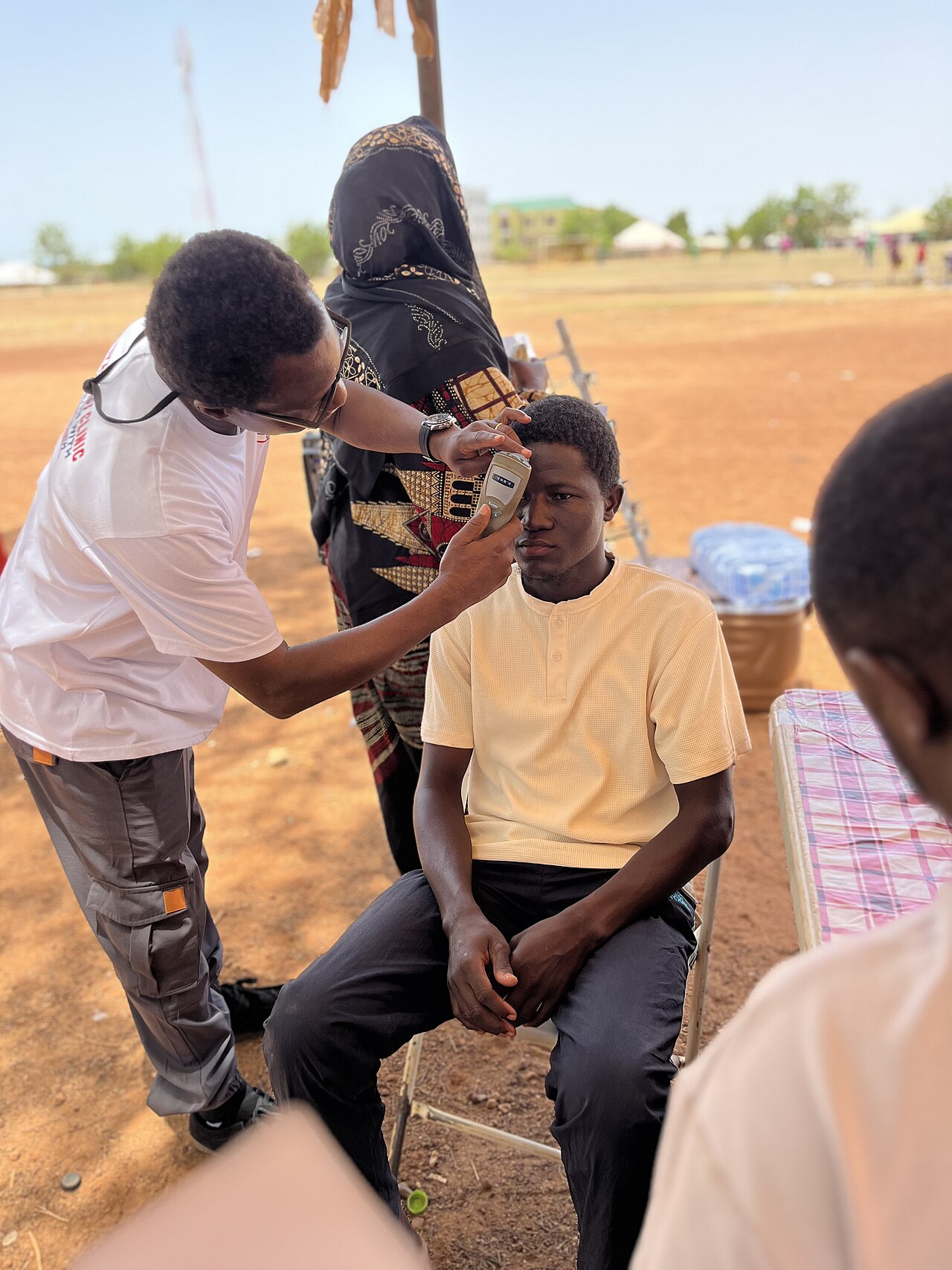
Screening in medicine is a strategy used to test for as-yet-unrecognised conditions or risk markers in individuals or populations without symptoms or signs of the disease being screened. Screening interventions are designed to identify conditions which could at some future point turn into disease, thus enabling earlier intervention and management in the hope to reduce mortality and suffering from a disease. Although screening may lead to an earlier diagnosis, not all screening tests have been shown to benefit the person being screened—overdiagnosis, misdiagnosis, and creating a false sense of security are some potential adverse effects. Several types of screening exist, including universal (population-based) screening, case finding, and targeted or stratified screening.
- Definition
- Testing for unrecognised conditions or risk markers in asymptomatic individuals or populations
- Purpose
- Enable earlier intervention and management to reduce mortality and suffering
- Potential adverse effects
- Overdiagnosis, misdiagnosis, false sense of security, inappropriate overuse
- Key criteria (1968 WHO)
- Condition should be an important health problem; there should be a treatment; facilities for diagnosis and treatment available; latent stage; acceptable test; understood natural history; agreed policy
- Key criteria (2008 WHO)
- Respond to recognized need; defined objectives; defined target population; scientific evidence of effectiveness; integrated programme; quality assurance; informed consent; equity and access; planned e
- Types
- Mass screening, high risk/targeted/selective screening, multiphasic screening
Lore & Background
These principles remain broadly applicable and include that the condition should be an important health problem, there should be a treatment, facilities for diagnosis and treatment should be available, there should be a latent stage, and the test should be acceptable to the population.
Reader's Guide
Screening is a cornerstone of preventive medicine, but its application requires careful balancing of benefits and harms. These criteria emphasize that the condition must be an important health problem, a treatment must exist, and the natural history of the disease must be understood. Common screening programs include cancer screenings (e.g., Pap smear, mammography, colonoscopy), depression screening, and newborn hearing tests. However, screening is not diagnostic and can produce false positives and false negatives. In the US, recommendations are provided by the United States Preventive Services Task Force; in the UK, by the UK National Screening Committee. The social determinants of health have also become a focus of screening, as seen in programs established under the Affordable Care Act.
Did You Know?
- Screening tests can have significant rates of both false positive and false negative results.
- Common screening programs include Pap smear for cervical cancer, mammography for breast cancer, and colonoscopy for colorectal cancer.
- In the US, screening recommendations are provided by the United States Preventive Services Task Force.
Early Foundations and the Hirschfeld Legacy
For much of the twentieth century, the medical understanding of gender diversity remained largely absent from mainstream discourse. That changed in the 1920s when physician Magnus Hirschfeld undertook formal research into what we now recognize as gender dysphoria and the broader landscape of human sexuality. Hirschfeld's work was groundbreaking not only for its scientific rigor but for its explicit advocacy on behalf of communities that society had long marginalized. His studies offered a fundamentally new lens through which to view gender identity, gender expression, and sexual orientation, representing the first sustained intellectual challenge to rigid societal norms around gender. Hirschfeld also introduced the term "transvestite," a label that has since evolved into the modern understanding of "transgender." Tragically, his life's work was cut short during the Nazi era in Germany, a period in which transgender individuals faced arrest and were forcibly sent to concentration camps. Hirschfeld's legacy endures as a reminder that the medical recognition of transgender people is both a recent achievement and one that has been violently interrupted before.
Institutional Care and the Johns Hopkins Era
The mid-twentieth century saw the emergence of dedicated clinical infrastructure for transgender patients in the United States. In 1966, the Johns Hopkins Gender Identity Clinic opened its doors, becoming one of the first American institutions to offer comprehensive care to transgender individuals. The clinic's multidisciplinary approach encompassed hormone replacement therapy, surgical procedures, psychological counseling, and other forms of gender-affirming healthcare. A defining feature of the clinic's protocol was the "Real Life Test," a program requiring prospective surgical patients to live in their desired gender role for a prescribed period before undergoing gender-affirming surgery. This requirement reflected the era's cautious, gatekeeping approach to medical transition. However, the clinic's existence proved to be temporary. In 1979, Paul R. McHugh, the newly appointed director of psychiatry at Johns Hopkins, ordered the clinic shut down, abruptly ending a significant chapter in the institutional provision of transgender healthcare in the United States.
Shifting Diagnostic Frameworks
The medical community's classification of gender variance has undergone significant evolution, though the trajectory has been neither linear nor uncontested. For centuries, medicine treated gender variance as a pathology. The World Health Organization maintained this framing by listing gender dysphoria as a mental disorder in the International Classification of Diseases until 2018. The American Psychiatric Association's DSM-5 similarly included the condition, a term that had previously appeared as "transsexualism" and "gender identity disorder" in earlier revisions. A notable shift came with the ICD-11 update in 2018, which introduced "gender incongruence," defined as a marked and persistent mismatch between an individual's experienced gender and assigned sex, while noting that gender-variant behavior does not automatically constitute a medical diagnosis. Yet the distinction between "gender dysphoria" and "gender incongruence" remains ambiguous in much of the literature. Researchers continue to debate whether medicalizing gender variance causes harm or whether diagnostic categories serve as essential gateways to necessary care. Systematic reviews further underscore the urgent need for standardized data-collection methodologies to better understand how prevalent these experiences truly are within the general population.
Mental Health Disparities and the Path Forward
Transgender individuals face mental health disparities that are stark and well-documented. Across various countries, an estimated 32 to 50 percent of trans people have attempted suicide, a prevalence researchers attribute to victimization, bullying, violence, social and familial rejection, and systemic discrimination in public sectors. Beyond gender dysphoria, trans populations experience major depression and generalized anxiety at rates far exceeding those of the non-trans population. While gender-affirming care can positively impact mental health and alleviate certain symptoms, its psychological benefits are often constrained by ongoing minority stressors. In response, psychotherapy and mental health assessments play an important supporting role, particularly in ensuring informed consent before medical transition begins. Current trans healthcare protocols, however, discourage making psychotherapy a rigid prerequisite for affirmative care and explicitly reject approaches that attempt to alter a patient's identity or steer self-exploration in a prescribed direction. For transgender youth, professionals are urged to create respectful spaces for identity exploration without using that process to delay care or reframe trans identity as pathology, since such tactics mirror conversion practices known to cause significant harm.
Gallery





Frequently Asked Questions
Who is Screening (medicine)?
Screening is a medical strategy that tests people showing no symptoms or visible signs of illness to detect early risk markers or pre-disease states. It targets asymptomatic individuals or whole populations rather than those already presenting with a condition.
What are Screening (medicine)'s powers/role?
Its core function is to catch a condition while it is still in a pre-disease or latent stage, opening a window for earlier treatment and management. The ultimate aim is to lower mortality and reduce the suffering a disease would otherwise inflict.
How does Screening (medicine)'s story end?
Although it can produce an earlier diagnosis, the arc does not always resolve positively—overdiagnosis, misdiagnosis, and a misplaced sense of security are well-documented risks. Not every screening test has been shown to deliver a net benefit to the person being tested.
Why is Screening (medicine) important?
It shifts the intervention timeline forward so problems are addressed while still manageable rather than after irreversible harm has occurred. The 1968 WHO framework set baseline criteria, requiring the condition to be a significant health problem, an effective treatment to exist, and an acceptable test to be available.
What are Screening (medicine)'s known weaknesses?
Adverse effects include overdiagnosis, misdiagnosis, false reassurance, and the inappropriate overuse of tests. The WHO criteria also demand that a true latent stage exists and that diagnostic and treatment facilities are accessible before a screening program is justified.
More in Medical Procedures And Treatments 1-23
Spotted an error? Know more?
This is a living reference — every entry is fact-audited, and reader corrections feed straight into our audit queue. Suggest an edit · See this site's audit record